Wednesday, September 3, 2025

Camel's Third Eyelid


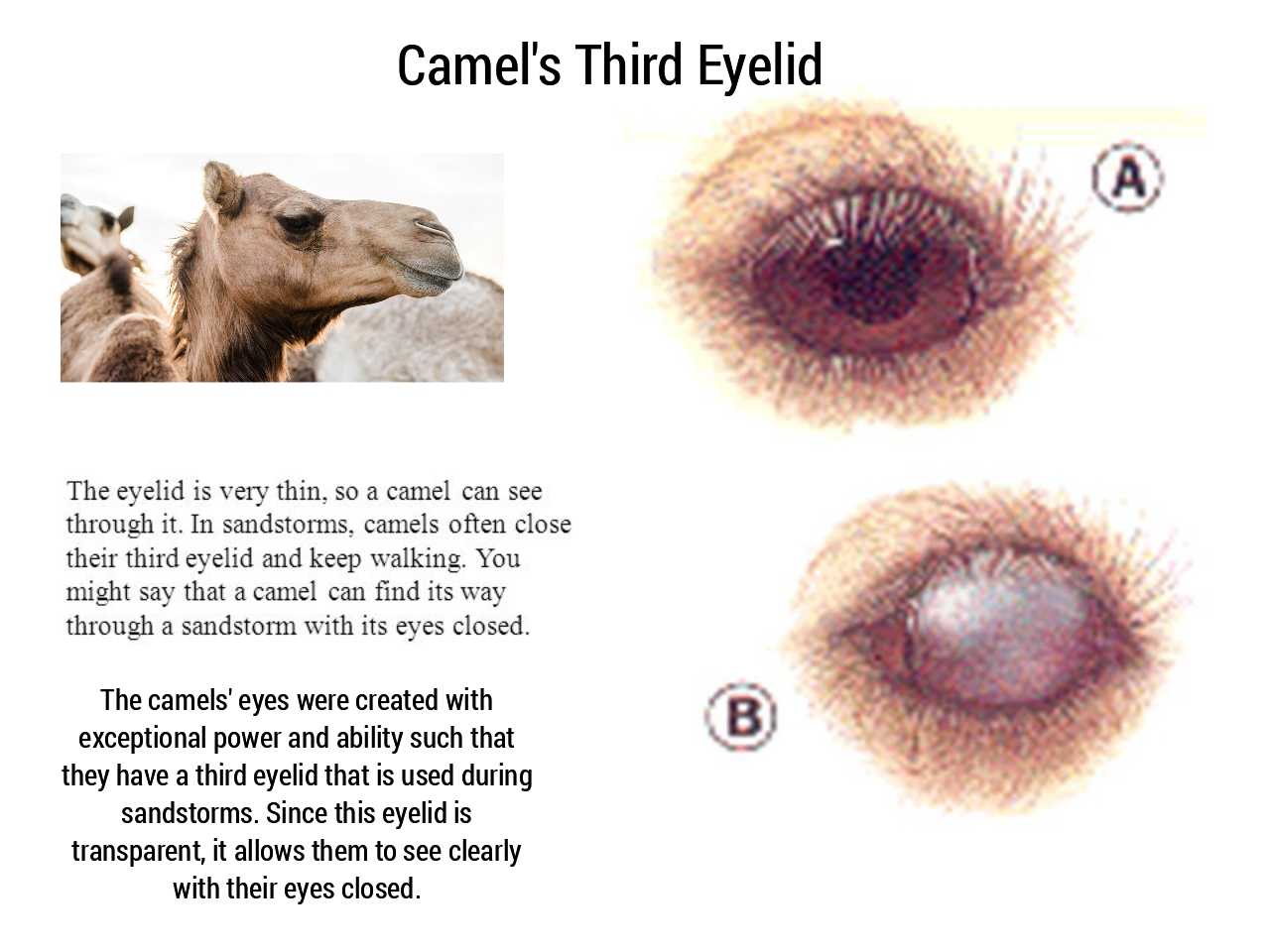
Scientific Facts : The camel's eyes were created with exceptional power and ability that have a third eyelid. A very thin transparent eyelid allows camel to see clearly through it. 
In sandstorms, camels often close their third eyelid and keep walking. You might say that a camel can find its way through a sandstorm with its eyes closed.
• The camel has three eyelids and two layers of eyelashes to protect itself from dust and sun. To protect their eyes, camels have long eyelashes that catch most of the sand when desert winds blow sand on to their eyes. 
• If sand gets into an eye a camel has a third eyelid to get it out. The extra eyelid moves from side to side and wipes the sand away.


Quran :  Allah says in Quran: "Have they (mankind) not looked at the camel and seen how it was created (perfectly, adapted to the harsh climate of the desert with so many uniquefeatures, qualities and capabilities)?" (Surah Ghaashiya 88:17)

 In this Verse, the Creator gently urges us, in words that the Believers take as an instruction, to meditate on His creation of the camel as a creature that points to the greatness of the Creator, the perfection of His power and the beauty of His control. 

We will see that the amazing facts that science has recently discovered about the camel explain to us some of the reasons why Allah, Most High, selected this amazing creature.... 


As the other beings, camel is too, created with many characteristics and then placed on earth as a sign of the such superior excellence physical features of the Creator in creation. it has been given to the service of mankind. 

On the other hand, mankind is given the responsibility to see similar miracles of creation throughout the whole universe and know the Creator of all beings is Allah.


Thursday, August 28, 2025

The profound power of reliance upon Allah


And whoever relies upon Allah - then He is sufficient for him.
Al Qur'an 65:3


Indeed, this verse from the Holy Qur'an, from Surah At-Talaq, reminds us of the profound power of reliance upon Allah. When we place our trust and reliance solely on Him, Allah becomes sufficient for us in all aspects of our lives. He is our protector, provider, and guide, and by entrusting our affairs to Him, we find peace, strength, and contentment. Relying upon Allah strengthens our faith and allows us to navigate life's challenges with confidence and resilience.


Monday, July 14, 2025

Righteous will be in Pleasure


Indeed, the Righteous will be in pleasure.
Al-Quran 82:13


This verse is from Surah Al-Infitar (Chapter 82, Verse 13) of the Quran.
 It refers to the ultimate reward for the righteous, those who have lived a life of faith and good deeds, promising them eternal happiness and bliss in the hereafter.

If you're reflecting on the meaning of this verse, it's a reminder of the positive outcome for those who follow the path of righteousness. 

This verse, "Indeed, the righteous will be in pleasure" (Quran 82:13), comes from Surah Al-Infitar (The Cleaving), which focuses on the Day of Judgment, the accountability of human deeds, and the final reward or punishment based on one's actions.

Deeper Meaning and Context:

The verse describes the fate of the righteous (Al-Abrar), those who live according to the guidance of Allah, maintain faith, and perform good deeds. In Islamic teachings, righteousness isn't limited to outward acts of worship like prayer and fasting but encompasses a lifestyle of kindness, honesty, justice, and compassion towards others.

The term "pleasure" (Na'eem) used in this verse implies much more than simple joy or happiness. It refers to the eternal and perfect state of bliss in Paradise, free from any hardship, sadness, or suffering. The pleasure mentioned is both spiritual and physical, encompassing every aspect of a person's being, as Paradise is described as a place of unimaginable delights prepared for the righteous.

The Concept of Reward for the Righteous:

Islam teaches that those who follow the path of righteousness will be rewarded in the Hereafter with pleasures that far surpass any joy they might experience in this world. Some scholars suggest that this verse emphasizes that the righteous will have peace, both in terms of physical enjoyment and emotional or spiritual fulfillment.

In contrast to the punishment prepared for the disbelievers or wrongdoers (which is mentioned in other verses of the same Surah), this verse highlights the eternal reward of those who remained steadfast in their faith and actions. The pleasures of Paradise, according to other verses in the Quran, include gardens beneath which rivers flow, the company of the pure, and the most important reward: the satisfaction of Allah and His eternal pleasure with them.

Reflection for Believers:

This verse serves as a source of motivation and hope for believers. It reminds them that the trials and challenges faced in this world for the sake of righteousness and staying true to one's faith will not be in vain. Allah is fully aware of everyone's actions, and ultimate success lies with Him.

In addition, this verse underscores the Quranic theme of accountability and recompense, where everyone will be judged fairly based on their deeds and rewarded or punished accordingly.


Monday, June 23, 2025

Iron is not natural to the Earth


 IRON
 Iron is not natural to the Earth. It did not form on the Earth but came down to Earth from outer space. This may sound strange but it's true. 
Scientists have found that billions of years ago the Earth was struck by meteorites. These meteorites were carrying iron from distant stars which had exploded. 

The Quran says the following on the origin of iron, WE SENT DOWN IRON WITH ITS GREAT INHERENT STRENGTH AND ITS MANY BENEFITS FOR HUMANKIND (57:25] 

God uses the words 'sent down' for iron. It is clear from the verse that iron is not an Earthly material, but was sent down for the benefit of humanity. The fact that iron came down to Earth from outer space is something which could not be known by the primitive science of the 7th century.

Monday, March 3, 2025

Ramdan Ke Masayeel

Ramdan Ke Masail

(“Bismillah-Hirrahman-Nirrahim:
Allah Ke Naam Se Shuru Jo Nihayat Maherbaan Aur Rahem Wala Hai”)


*Tamam Tareefe Uss Allah Azawazzal Ke Liye Jo Tamam Jahano Ko Banana Wala Aur Usey Palney Wala Hai, Aur Durood-o-Salaam Ho Uskey Aakhri Nabi-e-Kareem (ﷺ) Par..

★ Sabse Badee FAZILAT – Nuzul-e-Quraan Ke Liye Iss Mahine Ka Intekhab Kiya:
Sabse Badi Failat Ye Hai Ke Allah Rabbul Izzat Ne Iss Mahine Ka Intekhab Apni Aakhri Kitab Qurane Majid Ko Nazil Karne Ke Liye Kiya,…

Andaza Lagaiye Kitni Aham Baat Hai Ye Ke – Allah Rabbul Izzat Ne Apna Aakhri Qalam Utara ,.. Jiske Talluk Se Allah Taala Ne Quraan Hi Me Bayan Farmaya Ke –

❤️  Al-Quraan : “Ramzan Ka Wo Mahina Jisme Quraan Ka Nuzool Hua Insaniyat Ki Hidayat Aur Rahnumai Ke Liye”

 – [Sureh: Baqrah 2: Ayat-185]

Isiliye Ramzan Ka Mahina Quraan Ka Mahina Bhi Kehlata Hai ,.

*Aur Nabi-e-Karam (Sallallahu Alaihay Wasallam) Ka Mamool Tha Ke Har Ramzan Aap Ek Quraan Ki Tilawat Puri Kartey They ,..
*Tarawih Me Quraan Pura Karna Achi Baat Hai ,..
Lekin Rasool’Allah (Sallallahu Alaihay Wasallam) Tilawat Bhi Karte They,…


*Tou Koshish Karey Ki Hum Bhi Ek Quraan Pura Tilawat Karey Har Ramzan,..

Aur Kyunki Humari Zaban Arbi Nahi Hai Tou Hum Koshish Ye Karey Ki Har Ramzan Ek Quraan Tarjume Se Padhein,.. Kam-Se-Kam Saal Me Ek Baar Tou Pata Chale Ke Humara Rab Humse Kya Chahta Hai,….

*Aur Ramzan ke Baad Tak Agley Ramzan Tak Ek Tafseer Padh Lu ,…
*Tafseer Ka Fayda Ye Hoga Ke Unn Ayato Ke Ahqamat Kaise Hai ?… Unki Gehrayiya Kya Hai ?….. Unki Hikmatey Kya Hai ?….. Nabi-e-Karam (Sallallahu Alaihay Wasallam) Aur Sahaba Ke Aqwal Kya Hai Iske Andar Ye Sab Jan’ne Ke Liye Mufasareen Ki Tafseer Padhiye,..


…. Agar Aisa Mamool Hum Bana Ley Tou Andaza Lagaiye Ilm Me Kya Ijafa Hoga Humare? ,.. Jehan Bhi Khulega,…. Amal Me Pukhtagi Bhi Aayegi ,.. Aur In’sha’Allah-Ul-Azeez Hum Majbut Momin Banenge ….

Monday, November 4, 2024

Keep in touch with relatives and friends

  
       Keep in touch with relatives and friends
                             It's Sunnah


In Islam, the importance of maintaining family relations is paramount. The Holy Quran says, "And be careful of [your duty to] God in whose name you demand [your rights] from one another, and [to] the ties of relationship; surely God is ever watchful over you!" (4:1)

The descendent and successor of Prophet Muhammad, Imam Jafar As-Sadiq was asked about this verse. He said "It means the family relationship. Surely God the most high has ordered it to be regarded and has magnified it. Do you not observe that He has mentioned it with Himself." Maintaining the bonds of kinship is called silat ur-rahm in Arabic. The exact meaning of the word rahm is "womb." It is derived from the Arabic root word raheem which means "to have mercy on."

The Prophet ṣallallāhu ‘alayhi wa sallam (peace and blessings of Allāh be upon him) said:
“Anyone who wants to have his provision expanded and his term of life prolonged should maintain ties of kinship.” [Al Adab Al Mufrad]

Saturday, September 28, 2024

5. It is You we worship, and upon You we call for help.


It is you we worship, and upon you we call for help 
Al - Quran 1:5 

"Iyyāka na'budu wa iyyāka nasta'īn."

Translation: "It is You we worship, and upon You we call for help."


This verse from Surah Al-Fatiha emphasizes the fundamental concept of Tawhid (the Oneness of Allah) in Islam. It highlights two key principles:

1. Worship ('Ibadah): The verse declares that all forms of worship are directed solely to Allah. This affirms that no other being or entity deserves worship besides Him.


2. Seeking Help (Isti'ana): It emphasizes that all reliance and trust for assistance, both in worldly and spiritual matters, should be placed in Allah alone, as He is the ultimate source of help.


This dual concept strengthens the believer's bond with Allah, ensuring sincerity in worship and complete trust in His guidance.


Sunday, September 15, 2024

Seek help through patience and prayer.


O you who have believed, seek help through patience and prayer. Indeed, Allah is with the patient.
Al Quran 2:153


This verse is from Surah Al-Baqarah (2:153). It offers powerful guidance for believers, reminding them to turn to patience and prayer in times of difficulty. Allah promises that He is with those who practice patience (Sabr), reassuring us that enduring challenges with faith and steadfastness will lead to His support and mercy. It encourages believers to remain calm and seek divine help in all situations, knowing that Allah's assistance is always near.


Saturday, September 14, 2024

God's ultimate control over all things


"This is what God has willed! There is no power except with God!"
18:39


The phrase you mentioned is from Surah Al-Kahf (18:39) in the Qur'an. The full verse reads as follows:

"And why did you not say, when you entered your garden, 'This is what God has willed! There is no power except with God!' Though you see me inferior to you in wealth and children."

This verse is part of the story of two men, one of whom was proud and boastful about his wealth, while the other was humble and reminded him of God's will and power. The verse emphasizes the importance of attributing success and blessings to God's will rather than human effort alone. It teaches humility, the acknowledgment of God's ultimate control over all things, and the reminder that material wealth is fleeting without God's support.


Allah's Creation


This is the Creation of Allah. So show me what those other than Him have Created 
 Al Quran 31 : 11


"This is the creation of Allah. So show Me what those besides Him have created. Rather, the wrongdoers are in clear error."

In this verse, Allah challenges humanity to reflect on His creation and compare it with anything created by others whom people may worship besides Him. It emphasizes the uniqueness and greatness of Allah's creation, while highlighting the futility of worshipping anything or anyone other than Him. It invites people to recognize the divine power and wisdom behind the natural world.


Allah loves those who rely [upon Him]


Indeed, Allah loves those who rely [upon Him]
Al Quran - 3 : 159


The verse you're referring to is from Surah Aal-E-Imran (3:159), and it speaks about trust in Allah. Here is the translation of that specific portion:

"Indeed, Allah loves those who rely [upon Him]."

This is part of a larger verse that encourages the Prophet Muhammad (PBUH) to deal with his companions gently, to seek forgiveness for them, and to consult them in matters. It concludes by reminding the Prophet and the believers to place their trust in Allah, as He loves those who depend on Him with full conviction.

The full verse emphasizes the importance of mercy, forgiveness, consultation, and ultimately, reliance on Allah.


ALLAH MADE THE QURAN EASY TO REMEMBER


And we have certainly made the Qur'an easy to Remember 
So is there anyone who will be mindful ? 

 AL-QAMAR 54 : 17


Yes, this verse is from Surah Al-Qamar (54:17) in the Qur'an. The translation you provided is accurate:

"And We have certainly made the Qur'an easy to remember, so is there anyone who will be mindful?"

This verse is repeated several times in Surah Al-Qamar (verses 22, 32, and 40) to emphasize that the Qur'an is accessible for those who seek guidance and reflect upon it. It encourages people to contemplate the message of the Qur'an and to take heed of its lessons.


Allah created your mate of like nature in order that you might dwell with her in Love 


It is He who created you from a single soul, and made its mate of like nature in order that you might dwell with her in Love 
Quran 7:189


The verse you're quoting is from Surah Al-A'raf (7:189) in the Quran. It emphasizes the creation of humanity from a single soul (often interpreted as Adam) and the formation of his mate (Eve), reflecting the unity and shared nature of mankind. The purpose of this creation is to foster love, companionship, and tranquility between them.


This concept is echoed throughout the Quran, highlighting the importance of relationships built on love, mutual respect, and a sense of spiritual unity. It also serves as a reminder of the common origin of all human beings.


Wednesday, September 4, 2024

Allah's boundless love and mercy


Absolutely!
 Allah's love and mercy are infinite and encompassing. No matter how many mistakes we make, His forgiveness and compassion are always available to us. It's important to acknowledge our mistakes, seek forgiveness sincerely, and strive to improve ourselves while trusting in Allah's boundless love and mercy.

Wednesday, August 21, 2024

Jo bhi Peene waali Cheez Nasha Laaye wo Haraam hai

Hadees : Jo bhi Peene waali Cheez  Nasha  Laaye wo Haraam hai.


Hadees : Ummha-tul-Mominin Aayesha (RaziAllahu Anha) se riwayat hai ki, Rasool'Allah (Sallallahu Alaihay Wasallam) ne farmaya - 
"Jo bhi Peene Waali Cheez Nasha Laaaye wo haram hai." 
📕 Sahih Bukhari, Vol 1, 242


Allah Ta'ala Quran-e-Kareem me farmata hai

۞  Bismillah-Hirrahman-Nirrahim ۞
 "(Aye Rasool!) Aap se log Sharaab aur Juye (Gambling) ke baare me puchte hai tou Aap Unsey keh Dijiye ke in me badaa Gunaah hai aur Logon ke liye kuch faydey bhi hai aur unka Gunaah unke Nafaa se bahut bada hai." 
 📕 Al-Baqara 2:219

Tuesday, August 20, 2024

Baap ka Kirdar Aulad ki Tarbiyat me

J). Tarbiyat ka 10th marhala :

Baap ka Kirdar Aulad ki Tarbiyat me

Aulaad ki tarbiyat me sirf Maa ka hi Nahi balki Baap ka bhi ek Aham Kirdar hai. lekin Maa se jara Mukhtalif hai. Maa ka role ye hai ke “ke dekho beta tum ye sikh jao, agar tum aisa nahi karoge tou mai tumhare walid se tumhari shikayat karungi,. fir tumhe mare tou mujhe na kehna kuch.”

Tou walid sirf Nigah Daudane par rahenge baccho par “ke kya hua beta tumhara subha se kitni baat tumne apni walida ki nahi suni.” is tarha se samjhao usey , yahi aapka aham Role hoga

Lekin afsos ki baat hai ke Aaj bohot se martaba dekha jata hai ke Walid (baap) apna role ada nahi karte balki jakar Baccho ko Jyada bigaad detey hai,.. “kaha hai mera baccha, Subha se nahi dikha, kis kis ko Maara? bohot accha kiya” Subhan’Allah.

Baccha bolta hai Accha! Baap se tou strong support mil raha hai mujhe. ab mai kuch bhi kar ke aau tou Baap ladne ke liye tayyar hai meri taraf se.

Yaad rakhiye “Jin Ghar me Baap Baccho ko aise kaamo me support nahi karte un Ghar ke Bacche bahar ladna bhi pasand nahi karte, kyunki unhe maloom hai ke agar hum ladenge tou Baap ulta hume hi pitega.” Aur jin ghar me Baap hi kehta hai ke “Jao ladho! hum tumhare piche khade hai..” is tarha se targib dete hai galat kaamo ke liye wo Bacche bhi kaise Gundey nikaltey hai aur Baadme Baap ko bhi thoktey aur maarte hai ,.. kyun tou usne tarbiyat hi yahi di Apne Bacche ko.


✦ Baap ki Zimmedari :

Lihaja Baap ka role Aulad ki Tarbiyat me hai lekin mukhtalif hai maa ke mukable me. Maa ka role ye hai ke wo teacher hai jo sikhati rahengi, aur Baap ka role Examiner ka hai jo aa kar test lega  ka.

Jaise ke “kya kya sikha aaj ?,.. kya hua kaise raha tumhara muamla dinbhar ka ?,.. koi galat kaam tou nahi kiya aaj ?,.. Nasihat suni maa ki ?,.. School aur tuition gaye they ? ,. Arbi ki kitni tayyari hui ? ,.. falah aur falah is tarha sikhana beharhaal Baap ki Zimmedari me se hai.

Maa ki tarbiyat ke baad bacche ke liye 2 hi log hai. Ek Baap aur Dusra Ustad (Teacher). Ye do log hai jo iski tarbiyat Ghar se bahar karenge.

Jaisa ke tum yaha ja rahe ho tou aisa jao,.. logon ko Salam karo Beta,.. Masjid aise jaya karo,.. Saff me aise khadey raha karo,.. logon ko taklif na dena,.. padosiyo ko mat satana. is tarha se bahar ka role Baap ada karega aur uskey teacher, ustad ada karenge. ye do log ab aham Shakhsiyat hai Maa ke baad Zindagi me.

Tou jaha Maa Ghar me tarbiyat kar rahi hai, Kalimaat sikha rahi hai, usi tarha Baap usey bahar ke Aadab aur Akhlaq Sikhayega.


۞ Luqman (Alaihi Salam) ki Apne Bete ko Nasihate Baap ke liye Namuna hai :

Surah Luqman me Aap gour kijiye ke kya nasihate karte hai Luqman (Alaihi Salam) apne bete ko:

" Aye mere bete! Allah ki hi Ibadat karna, uske sath kisiko Sharik na thehrana, aur Namaz qayam karna, Roza rakhna,.. Takabbur mat karna, aur yaad Rakhna ke tum Gunaah chahe ek Patthar ke Andar karo ! Allah usko logon ke samne Zahir karega, khule chupe koi burayi na karna".
– (Mafhoom-e-Quran; Surah Luqman)


♥ SubhanAllah! tou Luqman (Alaihi Salam) ki Nasihate ek mukaam rakhti hai ke waisa role ada karey walid hazraat apni aulad ki tarbiyat me.

To be continue …
Thursday, July 4, 2024

Great reward for those who believe in Allah


Allah has promised those who believe and do righteous deeds [that] for them there is forgiveness and great reward.

Holy Qur’an, al-Ma’idah 9 


This verse from the Holy Qur'an emphasizes Allah's promise of forgiveness and great reward for those who believe in Him and strive to do righteous deeds. It serves as a source of hope and encouragement for believers, reminding them of the abundant mercy and blessings awaiting those who follow the path of faith and righteousness.